Hey there! I’m a supplier of scaffolding boards, and I often get asked this question: "How much weight can scaffolding boards hold?" It’s a crucial query, especially when you’re working on a construction site or any project that involves using scaffolding. Scaffolding Boards

First off, let’s talk about the types of scaffolding boards. There are mainly two common types: wooden and steel. Each has its own characteristics and weight – holding capacities.
Wooden scaffolding boards are super popular. They’re relatively lightweight, easy to handle, and cost – effective. But their weight – holding capacity can vary depending on a few factors. The species of wood is a big one. For example, oak is a very strong and dense wood. A well – made oak scaffolding board can hold a significant amount of weight. On average, a standard 3.9 – meter (13 – foot) long, 225 – millimeter (9 – inch) wide, and 38 – millimeter (1.5 – inch) thick oak scaffolding board can hold around 250 to 300 kilograms (550 to 660 pounds) of evenly distributed load. This means if you spread the weight out across the entire surface of the board, it can handle that much.
However, if the load is concentrated in one spot, the capacity drops. Let’s say you have a heavy toolbox placed right in the middle of the board. In that case, the board might only be able to handle around 150 to 200 kilograms (330 to 440 pounds) before it starts to show signs of stress. The condition of the wood also matters. If the board has knots, cracks, or is rotted, its weight – holding capacity will be much lower. A board that’s in poor condition might not even be able to hold half of what a good – quality one can.
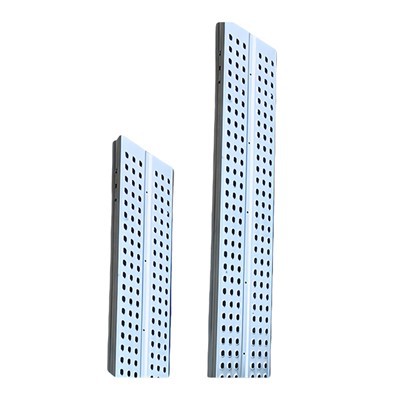
Now, let’s move on to steel scaffolding boards. Steel is known for its strength and durability. A steel scaffolding board can generally hold a lot more weight than a wooden one. A typical 3 – meter (10 – foot) long, 225 – millimeter (9 – inch) wide, and 3 – millimeter thick steel scaffolding board can hold upwards of 500 kilograms (1100 pounds) of evenly distributed load. That’s a huge difference compared to the wooden boards.
The reason steel can hold so much more weight is its high – strength material properties. Steel has a very high tensile strength, which means it can resist being pulled apart. And it’s also resistant to warping and bending under heavy loads. Just like with wooden boards, the way the load is distributed affects the capacity. If you have a concentrated load on a steel board, say a large piece of machinery placed on one end, the effective weight – holding capacity will be reduced. But even then, it can usually handle around 300 to 400 kilograms (660 to 880 pounds) without any major issues.
Another factor that affects the weight – holding capacity of scaffolding boards is the way they’re installed. If the boards are properly supported, with the right spacing between the supports, they can hold their maximum rated weight. For wooden boards, the supports should be placed no more than 1.2 meters (4 feet) apart. This helps to distribute the weight evenly and prevents the board from sagging or breaking.
For steel boards, the support spacing can be a bit wider, usually around 1.8 meters (6 feet). But it’s still important to make sure the supports are secure and level. If the supports are wobbly or not level, the board won’t be able to distribute the weight properly, and its weight – holding capacity will be compromised.
Now, let’s talk about safety standards. In many countries, there are strict safety standards when it comes to scaffolding and scaffolding boards. These standards are in place to protect workers and ensure the stability of the structure. For example, in the UK, scaffolding boards must meet the BS 2482 standard. This standard specifies the minimum requirements for the strength, durability, and other properties of wooden scaffolding boards.
For steel boards, they need to meet certain structural and safety requirements set by relevant authorities. When you’re buying scaffolding boards, it’s really important to make sure they meet these standards. This guarantees that you’re getting a product that’s safe and reliable. Using non – compliant boards is not only dangerous but can also lead to legal issues if something goes wrong on the construction site.
If you’re planning to use scaffolding boards for a project, it’s always a good idea to calculate the expected load carefully. Consider the weight of the workers, the tools and materials they’ll be carrying, and any other equipment that will be placed on the boards. Make sure to choose the right type of board based on the expected load. If you’re dealing with a heavy – duty project, steel boards are probably a better choice. But for lighter projects, wooden boards can work just fine.
As a scaffolding board supplier, I’ve seen all sorts of projects. Some are small DIY jobs, where people just need a couple of boards to reach a high shelf. Others are large – scale construction projects that require hundreds of boards. No matter the size of the project, I always make sure to provide high – quality boards that meet the safety standards.
I’ve also had customers who are unsure about which type of board to choose. In those cases, I always take the time to talk to them, understand their needs, and give them the best advice. For example, if a customer is working on a project where they need to move heavy equipment around, I’ll recommend steel boards. But if it’s a simple painting job where the load is mainly just the weight of the painter and a few small tools, wooden boards will be a more cost – effective option.
In addition to the type of board and the installation method, the environment also plays a role in the weight – holding capacity. If the scaffolding is set up outdoors in wet conditions, wooden boards can absorb moisture, which can weaken them over time. Steel boards, on the other hand, are more resistant to moisture, but they can rust if not properly coated. So, it’s important to consider the environmental factors when choosing and using scaffolding boards.
So, if you’re in the market for scaffolding boards, don’t hesitate to reach out. Whether you’re a contractor working on a big project or a DIY enthusiast with a small job, I can help you find the right boards for your needs. We have a wide range of wooden and steel scaffolding boards in stock, all of which meet the necessary safety standards.
If you’re not sure how many boards you need or which type is best for your project, just give me a call or drop me an email. I’ll be more than happy to have a chat with you, answer your questions, and help you make the right decision. Investing in high – quality scaffolding boards is an important step in ensuring the safety and success of your project.
Metal Scaffold Board References:
- Construction Industry Training Board (CITB) – Scaffolding manuals
- British Standards Institution (BSI) – BS 2482 for wooden scaffolding boards.
Jiangsu Jiasidun Machinery Equipment Co., Ltd.
As one of the leading scaffolding boards manufacturers in China, we warmly welcome you to buy bulk cheap scaffolding boards for sale here from our factory. All customized products are with high quality and low price. Contact us for pricelist and quotation.
Address: No. 8, Yanjiang Road, Hongqiao Town, Taixing City, Jiangsu Province
E-mail: jsjsd888@163.com
WebSite: https://www.cnjsdjx.com/
